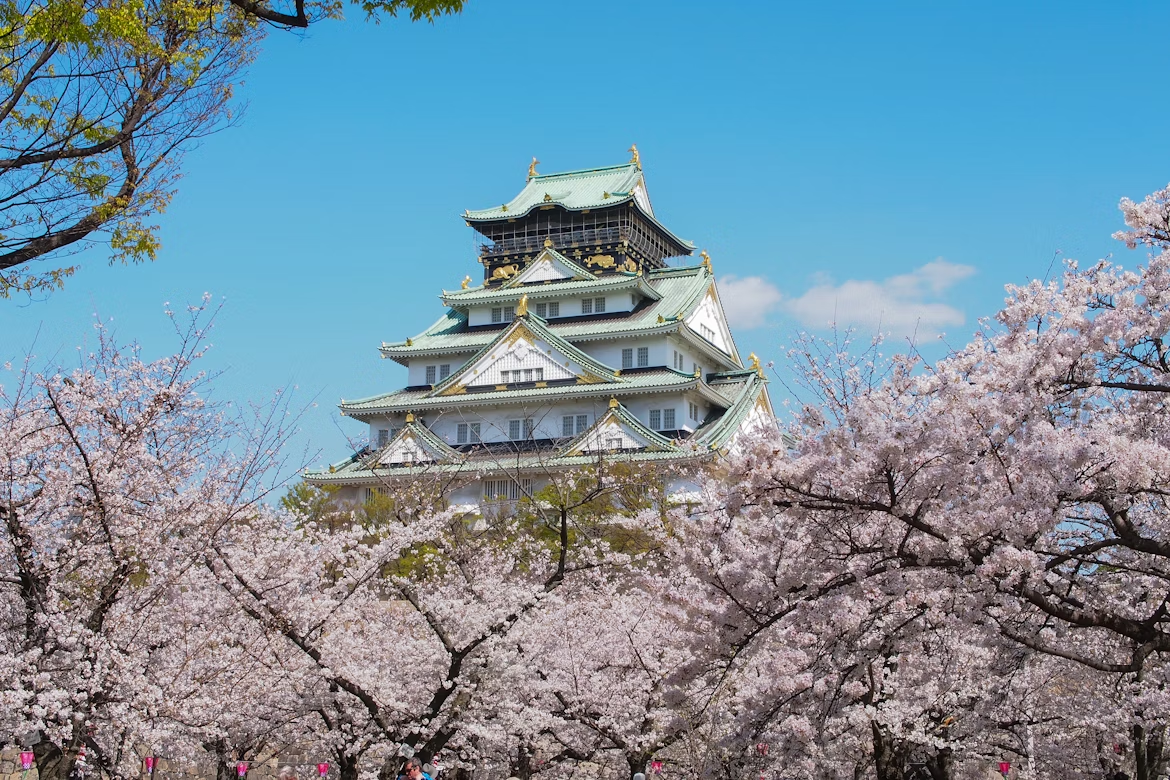
The Golden Spirit: Osaka Castle
Published Jan 2026 . 13 min read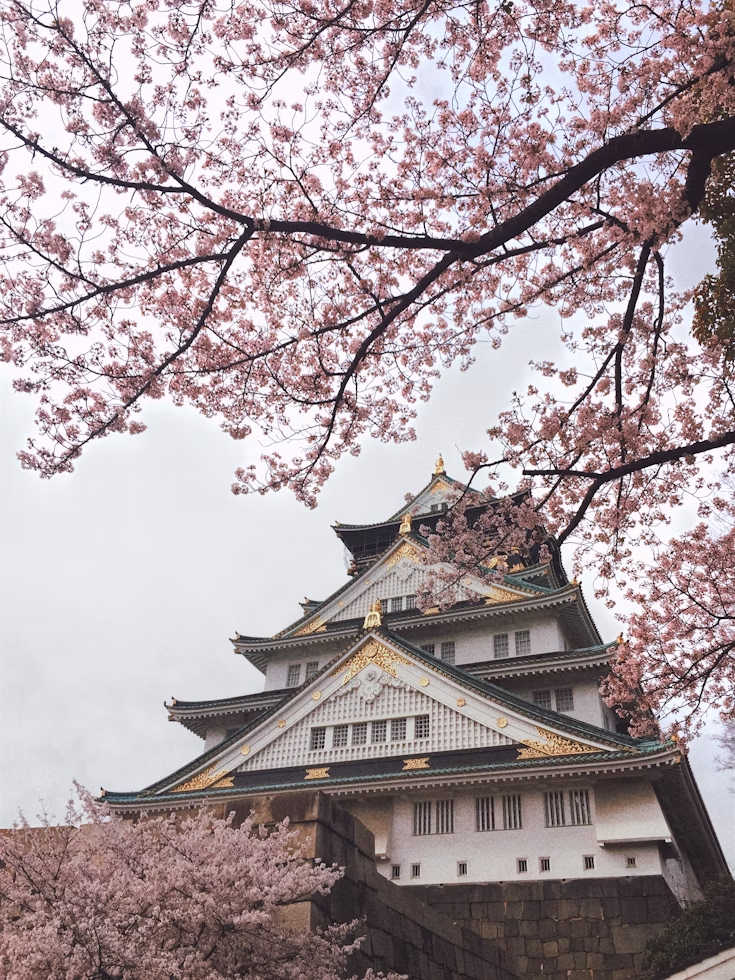
The Moats
The inner and outer moats are among the widest in Japan, spanning up to 90 meters, designed to keep even the most determined samurai armies at bay.
The Stone Walls
Known as 'Ishigaki', the walls utilize massive boulders. The 'Tako-ishi' (Octopus Stone) near the Sakura-mon Gate is the largest, weighing an estimated 108 tons.
At the heart of Osaka’s sprawling neon landscape lies a sanctuary of stone and gold. Osaka Castle (Ōsaka-jō) is more than a fortification; it is the physical manifestation of Japan’s unification.
The story of the castle begins in 1583, when Toyotomi Hideyoshi, the "Great Unifier," sought to build a citadel that surpassed all others. He intended for it to be the center of a new, unified Japan under his rule. For three years, 30,000 workers labored to create a keep adorned with gold leaf, meant to impress and intimidate in equal measure.
However, the castle we see today is a resilient phoenix. It has been destroyed by siege, struck by lightning, and leveled by air raids, only to be rebuilt by the hands of a people who refuse to let their history vanish into the clouds.The Golden Spirit: Osaka Castle
At the heart of Osaka’s sprawling neon landscape—a modern metropolis famed for its energy and kuidaore (eat-till-you-drop) culture—lies a sanctuary of stone and gold: Osaka Castle (Ōsaka-jō). More than a mere fortification, this majestic structure is the physical manifestation of Japan’s unification and a testament to the nation’s enduring resilience.
The Vision of the Great Unifier
The story of the castle begins in 1583, a pivotal year in Japanese history. It was then that Toyotomi Hideyoshi, the powerful general and statesman known as the "Great Unifier," sought to construct a citadel that would surpass all others in both scale and splendor. Hideyoshi, having risen from humble origins to become the de facto ruler of Japan, intended for Osaka Castle to be the center of a new, unified Japan under his unchallenged rule, a political and military headquarters worthy of his immense power.
The construction was an epic undertaking. For three grueling years, an estimated 30,000 workers labored tirelessly, hauling massive stones for the imposing walls and meticulously carving the intricate details. Hideyoshi spared no expense, ordering the keep to be lavishly adorned with dazzling gold leaf. This golden ornamentation was not just for show; it was a deliberate political statement, a symbol of his unprecedented wealth and authority, meant to impress allies and intimidate rivals in equal measure. The original main tower, completed in 1585, was truly magnificent, cementing Osaka's position as the new political capital.
A History of Flames and Fortitude
Despite Hideyoshi’s grand vision, the castle was not destined for tranquility. Its history is a dramatic cycle of construction, destruction, and rebuilding. After Hideyoshi's death, his successor and eventual rival, Tokugawa Ieyasu, besieged the castle in two legendary conflicts known as the Sieges of Osaka (1614–1615). The final defeat of the Toyotomi clan saw the original fortress entirely razed to the ground, its golden splendor turned to ash.
The Tokugawa Shogunate, however, recognized the strategic importance of the site. They rebuilt the castle, constructing an even taller main tower and more formidable stone walls to prevent its future use by rebels. These massive walls and moats are a defining feature of the grounds today. Yet, even the Tokugawa-era structure was vulnerable to the elements and fate. In 1665, the main tower was struck by lightning and burned down, leaving the central compound empty for over two centuries.
The Phoenix Rises
The castle we admire today is a resilient phoenix, a testament to the Japanese spirit of perseverance. It was finally reconstructed in 1931, funded through public donations, marking a powerful restoration of a national monument. Tragically, this rebuilt structure, along with the rest of the grounds, suffered severe damage from Allied air raids during World War II.
Yet, true to its history, the people of Osaka refused to let this symbol of their past vanish into the clouds. A major renovation in 1995-1997 restored the exterior to its 16th-century glory, including the signature gold-leaf accents and magnificent bronze tigers, while installing a modern museum interior. Today, Osaka Castle stands proudly, a majestic silhouette against the modern skyline, preserving the memory of the Great Unifier and reminding every visitor of its profound and often fiery history.
The Sakura Canopy
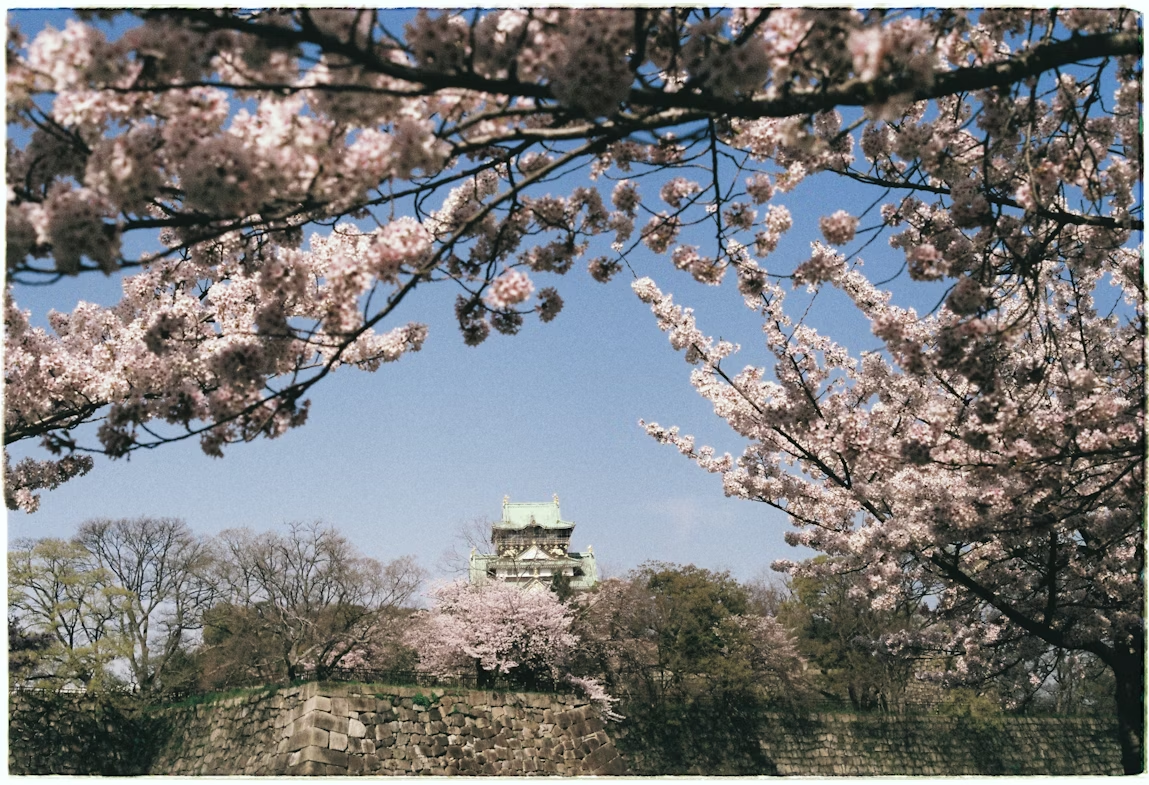
When April arrives, the castle grounds undergo a sensory shift. The Nishinomaru Garden, home to over 600 cherry trees, becomes a soft, rolling cloud of pink. For the Japanese, the Sakura represents the ephemeral nature of life—a beauty that is profound specifically because it is temporary.
As evening falls during the fleeting spring season, the iconic surroundings of Osaka Castle are utterly transformed by a breathtaking spectacle of light known as Yozakura, or night cherry blossom viewing. This cherished practice sees the myriad of cherry trees surrounding the castle grounds bathed in carefully positioned, gentle illumination. The artificial light beautifully accentuates the delicate pink and white blooms, casting a soft, ethereal glow across the landscape. This radiant display is reflected with stunning clarity off the polished surfaces and intricate architecture of the castle keep itself. Specifically, the light catches the distinctive, decorative elements—such as the elegant chidorihama (cusped gables)—of the castle’s uppermost tiers. The resulting spectacle is a vibrant palette of colors—the deep twilight blues of the sky, the soft luminescence of the blossoms, and the distinctive mint-green hue of the castle's gables. The visual effect is so strikingly beautiful and harmoniously composed that it feels less like a modern illumination and more like a scene directly "extracted" or lifted from an exquisite, masterfully created Edo-period ukiyo-e (woodblock print), perfectly capturing the spirit and artistry of old Japan.
Historical Significance
1615 AD
The Fall of the Toyotomi — The castle falls to the Tokugawa shogunate, ending the Toyotomi lineage and ushering in the peaceful Edo period.
1931 AD
The Modern Reconstruction — The main keep is rebuilt using ferro-concrete, funded entirely by donations from the citizens of Osaka.
A Living Landmark
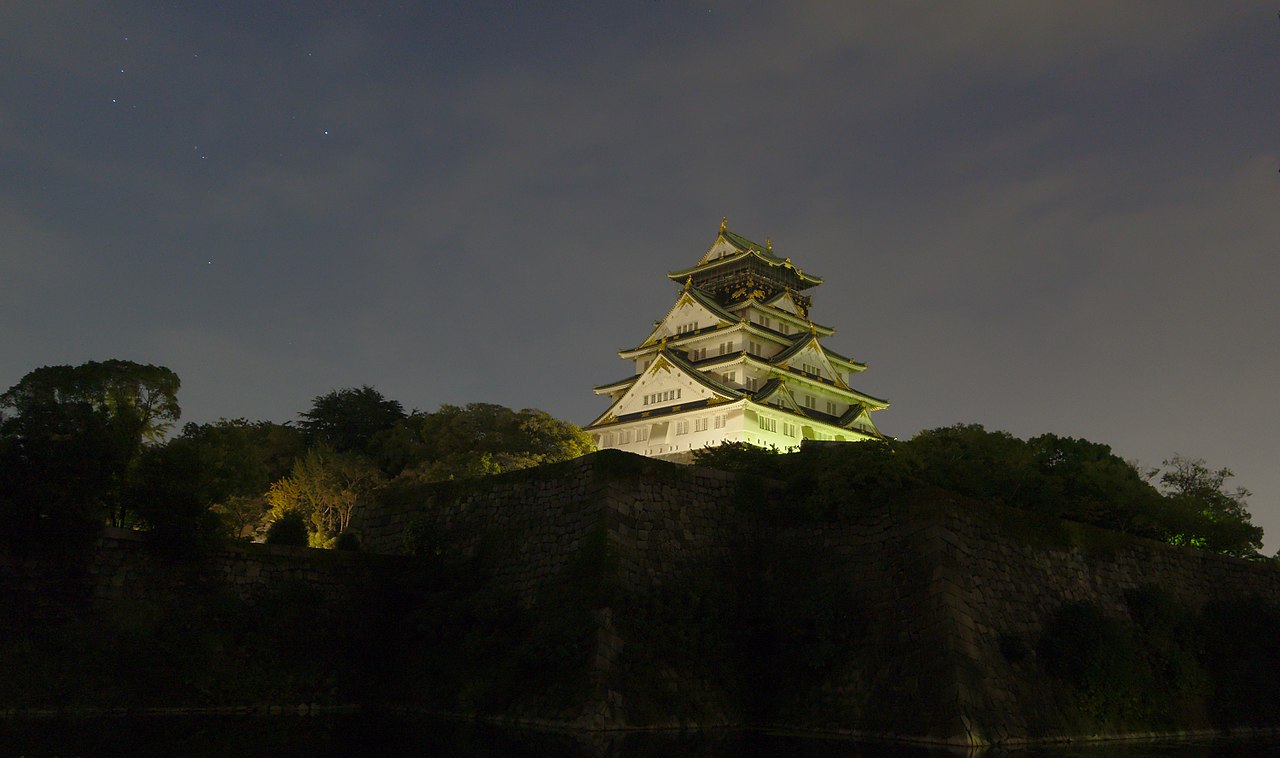
Unlike the hushed halls of many historic sites, Osaka Castle is far from a silent museum; it remains a dynamic and pulsating artery in the heart of the city. The very ground it stands upon is a testament to the seamless integration of past and present.
On any given morning, the expansive grounds surrounding the main keep burst with contemporary activity. You will find groups of retirees practicing the gentle, flowing movements of Tai Chi in the shadow of the imposing Otemon Gate, their synchronized motions echoing the discipline of the castle's former inhabitants. Meanwhile, dedicated joggers trace the scenic path of the massive outer and inner moats, their daily routines set against centuries-old stone walls.
This daily mingling of historical architecture and modern life is more than mere coincidence; it is a profound reminder that ancient Japan is not a closed, finished chapter to be admired from a distance. Instead, it serves as the deep, unshakeable foundation upon which the vibrant, modern city of Osaka continues to build, breathe, and thrive. The castle grounds are a communal space, a public park, and a historical monument all at once, symbolizing the enduring spirit of resilience and community that characterizes the city itself.
Credits
| Unsplash License |
| https://unsplash.com/license | |
| Fumiko Nishida | |
| https://unsplash.com/@pontanishida |
| Unsplash License |
| https://unsplash.com/license | |
| Nguyen Khiem | |
| https://unsplash.com/@photosyclist |
| Unsplash License |
| https://unsplash.com/license | |
| Tam Cong | |
| https://unsplash.com/@tamcong123 |
 | CC BY-SA 4.0 |
| https://creativecommons.org/licenses/by-sa/4.0/ | |
| Mc681 | |
| https://commons.wikimedia.org/wiki/User:Mc681 |
| CC BY 2.0 |
| https://creativecommons.org/licenses/by/2.0/deed.en | |
| SuperTaiyaki | |
| https://www.flickr.com/photos/supertaiyaki/ |
Join Our Sites

Just Nihon Travel is a specialized tourism service offering Muslim-friendly travel from Indonesia to Japan, providing customized itineraries with halal food, accommodations, beauty tours using halal-certified products, medical tours with top hospitals, special arrangements for Muslim women ensuring privacy and modesty, anime cosplay tours, English and Indonesian-speaking guides, prayer facilities with on-time prayer arrangements, and immersive experiences like a one-day sushi-making course.